The 20 per cent tax: Why your hotel website is leaking revenue to OTAs

There is nothing more frustrating than a potential guest spending 20 minutes browsing your carefully curated hotel website, only to disappear and just a few minutes later book via an OTA.
They’ve checked out your facilities, clicked through the image gallery, and perhaps even read a blog post. But when it comes to making that reservation, they chose Expedia or Booking.com, and you watch up to 20 per cent of top-line revenue slip away in third-party commissions. It’s incredibly frustrating. Why?
This isn't a baseline pricing failure. It is often a structural friction issue hidden within your current hospitality marketing strategy.
The disappearing act: why guests bolt to OTAs

Guests do not possess an inherent loyalty to third-party booking channels; they simply crave absolute convenience. When your direct website forces a user to navigate slow-loading pages, confusing room tiers, or a tedious multi-step checkout, their confidence crumbles.
OTAs counter this vulnerability with a beautifully standardised, frictionless user experience and immediate confirmation. They are like the Amazon of hotel bookings.
OTAs are often quick to adapt to new technology, like AI-powered personalised recommendations and integrated payment gateways. They also really focus on the mobile booking experience (60 per cent of OTA bookings happen on mobile, according to marketgrowthreports.com)
They have conditioned global luxury travellers to expect one-click convenience, making even the slightest digital clumsiness on a direct hotel site feel intolerable.
Those digital missteps are like holes in your pipeline, letting users leak through and drop off before completing a booking.
But it’s not all bad news. Despite rapid OTA growth, direct booking platforms maintained about 55 per cent of global travel transactions in 2024. OTAs have also suffered some serious data breaches in recent years, affecting trust, and since Covid, some are seen to offer less flexible cancellation policies.
Finally, guests are catching on to the idea that booking direct can be cheaper, with commissions sometimes pushing the price up on OTA sites.
Hotel website marketing: pinpointing the user drop-off
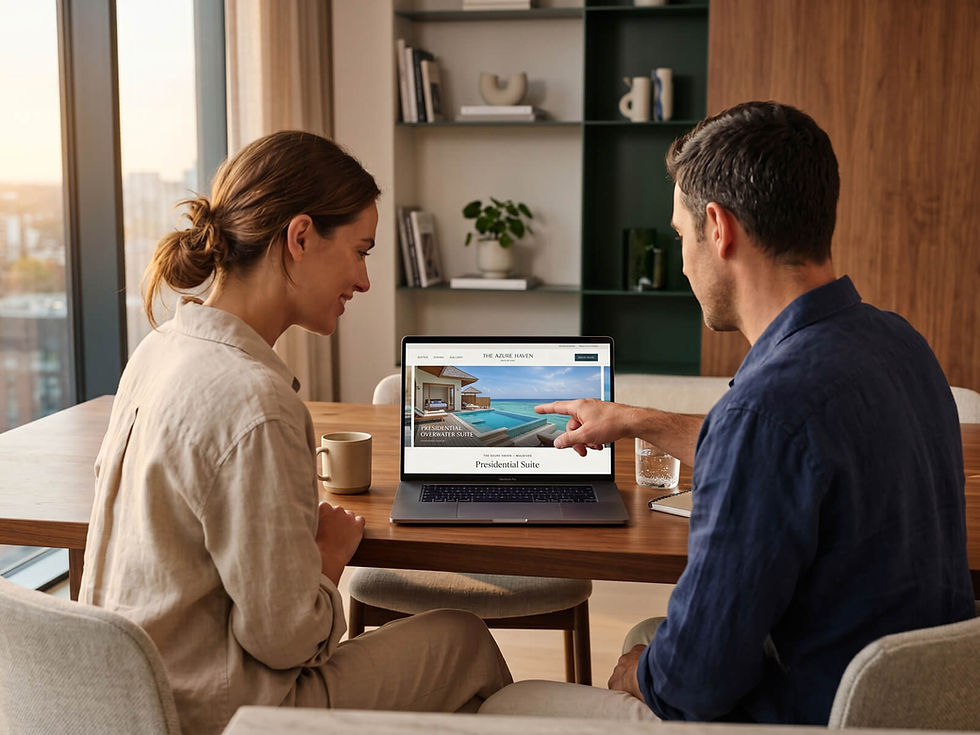
When it comes to tracking where customer drop-off happens, your website analytics are your greatest weapon.
For example, a high bounce rate on your room selection page indicates an entirely different structural problem than cart abandonment at the final payment gateway.
The former implies that your room imagery, pricing layout, or initial value proposition lacks immediate clarity. The latter means your checkout sequence introduces sudden, unnecessary friction or hidden fees that break the spell.
You have a variety of options for tracking this data and discovering where the issue lies.
Establish event monitoring for critical user behaviours, including:
Selecting the "Book Now" button
Checking room dates and availability
Finalising a reservation
Sending a request through the contact form
You can define these as conversions within GA4 to visualise the data in your analytics dashboards. If your reservations are processed on an external URL, implementing cross-domain tracking is vital to prevent session fragmentation.
For example, if your main website is 'hotel.com' but your booking engine is 'reservations.hotel.com', standard analytics will think the user left your website entirely the moment they try to book. Cross-domain tracking links these two together so you can see the complete journey.
Booking engine tracking
Verify if your booking engine supports GA4 data feeds or conversion tracking pixels for platforms like Meta and Google Ads. If your current provider lacks these integration capabilities, it may be time to transition to a system that aligns with modern analytical standards.
Heatmaps and session recordings
Platforms such as Hotjar or Microsoft Clarity provide a window into guest behaviour on your most important pages.
A heatmap works by giving you a colour-coded visual representation of your website pages, with red/orange colours showing where most activity takes place and blue/green areas showing ignored areas. It is a way to show you exactly where people are clicking.
For example, you may see that people are clicking on a beautiful spa image on your site. From this, you can ascertain that they’re expecting it to lead them somewhere, like to a spa booking page. If it doesn’t, that is something you can rectify.
Equally, scroll maps can show you how far down potential guests are scrolling. If your great special offer is appearing below that, then you know you need to bump it up the page.
Session recordings are even more insightful, showing you playbacks of how users interacted with your site, so you can see where they hesitate, showing confusion, or where they try to click a link that could potentially be broken.
Together, these elements offer an effective way to see the reality of your website, rather than just guessing why direct bookings are not happening
Booking funnel analysis
Trace the guest's path from their initial arrival on your landing page to the final booking confirmation. Identifying the precise moments where users disengage or determining if they exit before even checking availability is crucial. Analyzing this funnel allows you to effectively rank which elements of the user experience require immediate attention.
At Peregryn, we don’t guess where your revenue is escaping. We analyse the metrics to see exactly where the connection snaps. It goes beyond just following the path of click-throughs — we also check to see how mobile-friendly your website is. One study found that hospitality sites showed a significant drop in conversions from mobiles compared to desktops, even though the majority of traffic is through mobile devices. This indicates that many sites, rather than optimising for mobiles, are actually making it harder for their primary audience.
How to execute a flawless hotel marketing plan

Let’s pull back the curtain entirely and show you how it’s done. To reclaim those profit margins, you need to systematically audit and eliminate every single point of friction in the guest's path.
Here’s how we dismantle the digital roadblocks by streamlining the digital journey:
Technical and UX fixes
A seamless interface: Reduce the number of clicks required from the landing page to final payment. If your system forces a guest to re-enter arrival dates or scroll through complicated add-ons before displaying the final cost, they will leave.
Mobile-first: The importance of a mobile-first approach cannot be overstated; more than 70 per cent of traffic to hospitality sites is through mobile devices.
Content & trust fixes
Evocative storytelling: Step away from sterile amenity lists. Your words must make the guest feel the linen and taste the estate-grown wine. Vague copy breeds hesitation, whereas vivid, benefit-driven narratives reassure guests that booking directly guarantees the premier experience.
Unmistakable trust signals: Display your direct-booking perks prominently alongside the price widget. Whether you offer complimentary artisan breakfast, private airport transfers, late checkouts, or bespoke welcome gifts — whatever it is, make the superior value proposition instantly obvious.
Emotional resonance: Use premium photography and immersive video tours to weave a compelling local narrative that connects with guests.
Social proof: Feature genuine, recent guest testimonials to build immediate trust and booking certainty.
Value propositions & incentives
Price confidence: Implement a best-rate guarantee to ensure potential guests they are securing the most competitive deal by booking directly.
Booking flexibility: Provide superior cancellation terms for direct guests that third-party sites cannot replicate.
Local discoverability: Maintain a peak Google Business Profile with current imagery and data to capture local search intent.
Direct loyalty: Exchange instant rewards, such as room upgrades or discounts, for guest contact information to build your private database.
Turning one-time visitors into lifelong advocates

Plugging the revenue leak by avoiding commissions goes far beyond a single digital transaction. Once you capture that initial booking — regardless of the channel — your focus must pivot entirely to hospitality consumer retention. True magic lies in maximising lifetime value through genuine human connection.
If your guest has booked through an OTA, their email address is masked. But you can still capture guest data gracefully during their stay. Just make sure it feels like a benefit to their stay, rather than a marketing trap. Consider a pre-arrival preference questionnaire or perhaps a free WiFi login portal, or a QR code to access room service extras.
From there, you can engage your guest with highly tailored, post-departure communication. For example, you can offer exclusive, private rates for their next visit - by sending these directly over email, they remain entirely invisible to third-party scrapers.
Modern luxury travellers seek out experience-led personalisation over generic point systems. When you treat guests as esteemed VIPs rather than line items on a ledger, you foster an emotional bond that third-party algorithms cannot replicate. Consider adding notes to your CRM. Perhaps they are vegetarian and you can have oat milk in their minibar fridge for the next visit - it’s a way to build a relationship that shows your guest you really value them.
Loyalty programmes have a lot to offer here, incentivising guests to remain in contact with you and benefit from perks that are only available for direct bookings. It also offers more opportunity to capture personal information that you can later use to enhance their stay.
Plug the commission leak
You do not need to lose 20 per cent of your hard-earned revenue to OTA commissions. By transforming your digital architecture, sharpening your hotel brand narrative, and mastering your data, you can permanently shift the balance of power back to your own channels.
Our team at Peregryn acts as a seamless extension of your internal marketing department, giving you the exact blueprints to capture, convert, and keep your ideal guests. We specialise in executing a flawless digital marketing strategy for hotels.
Get in touch with us today to coordinate your comprehensive hotel website audit and reclaim your direct conversions.


