The end of the theme park tourist: Why boundaries are the new luxury in hospitality

Anti-tourism marches in Barcelona and Mallorca. Rising visitation fees in Venice and a ban on short-term holiday lets in Lisbon. The message is clear, uncontrolled tourism is over.
The negative impacts of mass tourism are well documented. For operators whose balance sheets are heavily indexed on leisure travel, this backlash presents a severe operational threat.
For decades, hospitality operated under a transactional assumption that paying for access granted a license to consume a destination without limits. Hoteliers want to break that extractive model, too, but they often fear that setting rules or managing guest behaviour might alienate their audience and damage the bottom line.
This operational pivot is no longer theoretical. In her recent market commentary on the flattening of regional food heritage, Peregryn director Sarah Gordon outlined a stark commercial reality: hospitality brands must actively defend their local ecosystems or face terminal yield erosion.
Restriction is the new premium. Protecting your environment isn't a CSR initiative; it is the ultimate expression of modern luxury.
At Peregryn, our luxury travel experts argue that hospitality brands can no longer sit passively on the sidelines, pretending their property walls insulate them from local resentment. If you want to protect your asset value, your brand equity must be actively tied to protecting the place you call home.
The strategic response is to elevate the guest journey to an exclusive, members-only tier of respect. High-net-worth, responsible travellers do not want to stick out as oblivious, disruptive consumers. They crave the quiet confidence that comes with cultural fluency. Giving them the real rules of the house isn't a restriction—it is the ultimate expression of premium, insider service.
Death of the passive host

Progressive destination management organisations have spent years searching for psychological interventions that can reshape visitor impact and encourage a more thoughtful tourism, sometimes even before travellers arrive.
We’ve seen the rise of formal travel pledges, such as the Palau Pledge, where arrivals must sign an environmental declaration stamped directly into their passports. The New Zealand Tiaki Promise sees visitors required to commit to care for the country, and Hawaii’s Malama framework promotes volunteer opportunities for tourists to mālama (give back) to the islands.
These initiatives are highly successful because they leverage commitment psychology. At the exact moment of booking or entry, they set a gentle psychological boundary that filters out entitled, transactional mindsets while instantly appealing to high-yield, culturally curious guests.
Independent hotels can easily adopt this architectural logic, stripping away bureaucratic language and re-packaging it as an insider style guide. Instead of issuing heavy-handed, condescending prohibitions, you reframe local decorum as exclusive cultural knowledge.
Consider a historic resort positioned on the southern Italian coast. Instead of a sterile room notice stating “Do not wear beachwear in town,” you could add a note in an email sent a few days before arrival, reiterating how much you are looking forward to welcoming your guests and adding something like:
“Sorrento comes alive in the evening with a sophisticated, tailored style. To help you blend in with the residents at our favourite tucked-away trattorias, we highly recommend packing linen cover-ups and sharp evening wear.”
You can apply this same choreographic lens to regional distribution. Frame the choice to skip a heavily congested cathedral plaza during peak hours not as an inconvenient restriction, but as a privileged insider tip.
Direct your guests toward a family-owned leather workshop down a quiet side street, presenting it as an exclusive itinerary asset. Recommend your city’s heritage restaurant, where the locals eat on special occasions. In this way, you simultaneously protect the city's living heritage, support the hyper-local economy, and enrich the guest's personal travel narrative without ever sounding preachy.
Re-engineering the meaning of loyalty

The traditional mechanics of hotel loyalty are broken. Points-based systems that reward raw consumption with generic, artificial tiers are not connected to their destinations, and feel entirely out of sync with contemporary luxury expectations.
Smart municipalities are already demonstrating an alternative path: Copenhagen’s CopenPay programme successfully rewards green actions like cycling or urban cleanup with free museum access or complimentary boat rentals.
Independent hotels can steal this framework to pioneer so-called impact perks.
Gamifying local respect within a boutique property requires aligning your real operational savings with authentic cultural rewards. If a guest opts out of daily room cleaning, do not simply leave a boilerplate cardboard card on the bed thanking them for saving water while your housekeeping margins improve.
Instead, intercept them dynamically. Send a complimentary round of cocktails crafted from hyper-local, wild-foraged botanicals directly to their table at dinner. Add an accompanying note, explicitly thanking them for helping protect the specific regional water table that feeds the valley's historic vineyards, for example.
The financial return here is beautifully circular. You significantly reduce your daily linen, laundry, and chemical overheads, while providing a high-margin, memorable hospitality gesture that reinforces your brand's core values.
The art of architectural gatekeeping

Allowing a visitor to walk out of your lobby and inadvertently violate a local law is a failure of your property’s physical choreography.
When historic city centres start introducing heavy fines (e.g. for walking through public squares in swimwear or carrying noisy wheeled suitcases down ancient stone steps) a passive host simply shrugs and blames local government. An active gatekeeper relies on choice architecture — the deliberate design of physical environments to naturally encourage positive human behaviour.
Instead of letting guests wander straight from the pool deck into the town's historic streets in their beachwear, a thoughtful property installs a styled, transition lounge positioned precisely between the beach club exit and the street gate. Here, guests encounter refreshing mist stations, valet shoe-care services. Perhaps you could even consider a wardrobe of high-quality, branded linen overshirts available to borrow for their urban stroll.
You are physically intercepting a potential cultural friction point before it ever hits the local community. The neighbourhood remains protected, the residents view your business as a respectful ally, and the responsible guest experiences the intervention not as a reprimand, but as a thoughtful amenity that enhances their personal comfort.
You can apply the same spatial philosophy to properties bordering sensitive cultural or sacred districts. For an urban boutique estate located steps from historic temple sites or centuries-old cathedrals, the departure courtyard can be engineered as a preparation zone. Rather than displaying rigid signs outlining strict religious dress codes, the exit lobby functions as a design-forward wardrobe vestibule. Here, guests are presented with beautifully folded, complimentary wraps crafted by local textile artisans. If your budget doesn't stretch to providing these free of charge, you could add a small store area where people can purchase them, and use it as an opportunity for localised storytelling of the women who weave the fabric from recycled materials, etc.
Or properties with high-energy evening destinations in quiet, residential neighbourhoods can use architectural layout to manage noise pollution. Instead of plastering defensive "please respect our neighbours" notices around the exit doors — which immediately shatters the premium evening mood — you could design a physical decompression path. The exit corridor transitions into a winding, open-air garden walkway lined with deep, sound-absorbing living walls and low-level, warm amber lighting. The narrow, curving geometry of the path naturally forces guests to slow their walking pace and lower their speaking volume as they exit.
Empowering staff to become luxury stewards
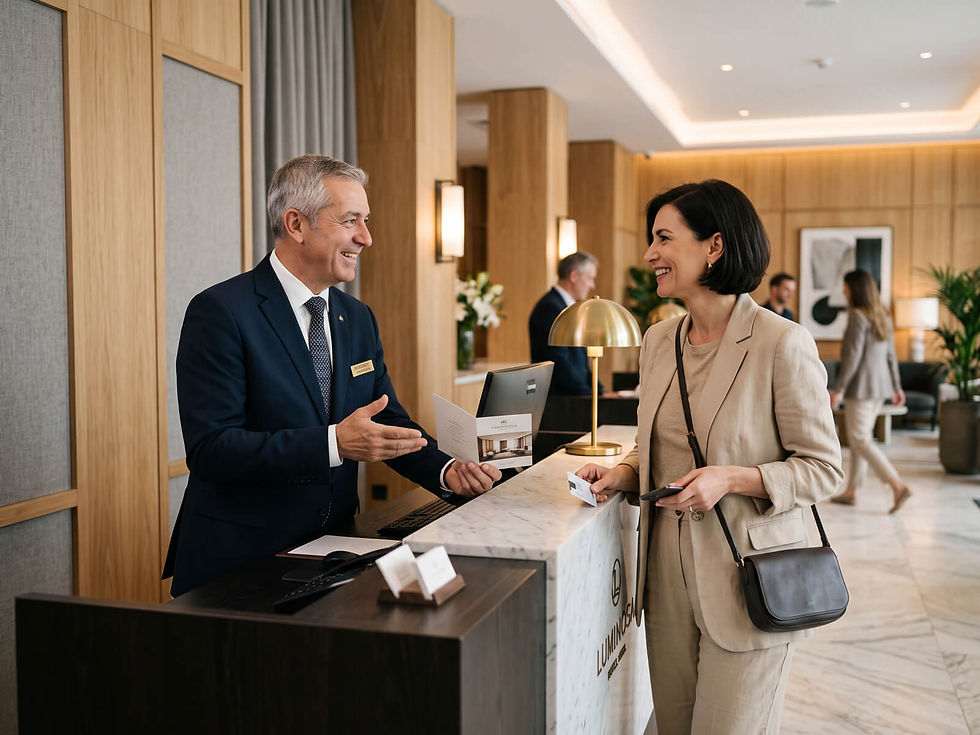
The ongoing recruitment and retention crisis in global hospitality cannot be solved by simply adjusting hourly wages. In a market where front-of-house talent is exceptionally scarce, the fastest way to lose your best people is to force them to tolerate entitled or abusive consumer behaviour under the outdated banner of unconditional service. Progressive brands are replacing this dynamic with a firm operational framework: the implicit Guest Contract.
This strategy gives your front-of-house team the explicit authority and agency to politely but firmly establish boundaries with visitors who disrespect local cultural norms or staff members. When your leadership team visibly prioritises the dignity of your local staff over a disruptive guest’s short-term spend, your internal culture transforms. Staff retention skyrockets because your team feels protected, which in turn allows you to build a stable, fiercely loyal cohort of local experts.
It doesn’t have to be punitive. Sophisticated travellers don’t want clinical, robotic interactions, or to feel like children being told off. They crave genuine human connection with the destination's real custodians. Empower your team to actively share their personal regional traditions, narrate the history of their home neighbourhoods, and contribute directly to the property's operational insights. By compiling these grassroots staff recommendations into a beautifully produced printed asset for arrival suites, you simultaneously validate your workforce’s cultural capital and deliver an irreplaceable insider asset to your guests.
Strategic copywriting: Enforcing house rules

The primary anxiety preventing hoteliers from establishing clear behavioural boundaries is the spectre of the negative online review. Operators worry that any introduced friction will immediately manifest as a scathing penalty on public forums. But the difference between an offensive restriction and an elegant house rule lies wholly within your copywriting and hotel brand communication strategy. You can transform those blunt rules into shared, exclusive rituals. There are three simple approaches we suggest at Peregryn:
Reframe restrictions as "Insider Access": Instead of printing a clinical warning that says “Do not take photographs of the local residents,” your in-room literature should read: “To preserve the unhurried, undisturbed magic of our village — and to grant you the rare gift of absolute privacy — we maintain a thoughtful phones-away policy within the historic market square.” You are no longer restricting their freedom; you are selling them entry into a protected sanctuary.
Storytelling over scolding: Don’t command a guest to conserve resource utilities via a generic bathroom sign. Tell the real narrative of your environment. Explain that every drop of water running through their suite flows from a specific alpine glacier that feeds the village's ancient vineyards down the hill. Turning off the tap ceases to be an administrative chore and becomes a meaningful act of participation in a grand regional narrative.
The omnichannel echo: This baseline of respect shouldn’t be hidden away in a secondary digital document. It must be woven deeply into your brand’s operational DNA, guiding your social media captions, shaping the exact verbal scripts used by your reservations team, and anchoring the arrival welcome delivered by the General Manager. Consistency is what transforms a list of complaints into an authentic hotel brand identity.
The ROI of respect

As historic destinations implement strict visitation caps and local communities push back against unchecked commercial exploitation, the era of treating the world as a disposable theme park has come to an end. But at the same time, the tastes of the world's highest-spending travellers have evolved. The progressive luxury consumers of 2026 are actively walking away from properties that insulate them from reality, choosing instead to support brands that act as fierce cultural stewards of their environments. This represents an opportunity for smart independent hotel brands.
Don’t see operational boundaries as a threat to your bottom line; but as your most powerful tool for long-term yield protection. When your independent property commits to active gatekeeping, you naturally filter out high-maintenance, low-yield nuisance tourism and attract an elite tier of guests who view respect as the ultimate luxury marker.
Take a critical, objective look at your current brand footprint. Is your marketing messaging inviting transactional consumers who treat your destination like a photographic backdrop, or is it attracting the culturally literate travellers who will protect your yields for the next decade?
Re-engineering your positioning, refining your verbal identity, and building a defensible digital ecosystem are no longer optional, they are prerequisites for survival. Peregryn’s hotel brand consultants engineer the narrative frameworks that allow independent properties to rewrite the rules of engagement, command absolute rate authority, and secure long-term yield.